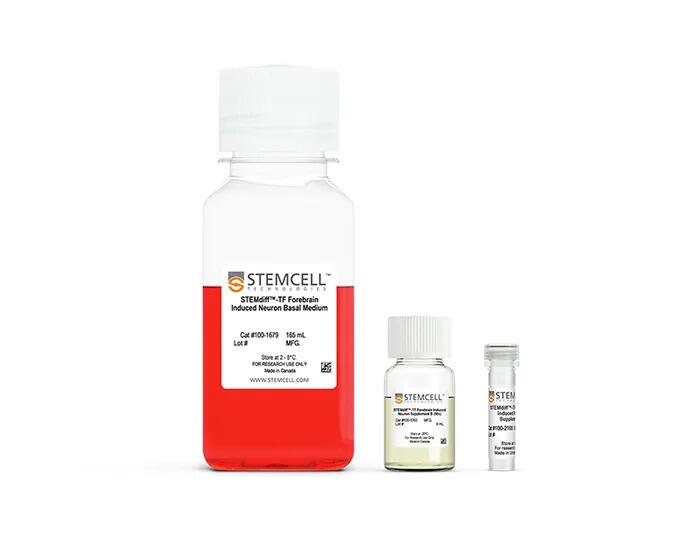
STEMCELL Technologies STEMdiff STEMdiff -TF Forebrain Induced Neuron Differentiation Kit
- 研究用
- 新製品
STEMdiff™-TF Forebrain Induced Neuron Differentiation Kit を使用すれば、ヒト多能性幹細胞(hPSCs)からわずか5日間で前脳ニューロンを迅速かつ効率的に作製できます。本キットは脂質ナノ粒子(LNP)を用いることで、ゲノムDNAに組み込まれることがないNeurogenin-2(NGN2)mRNAを細胞に導入し、転写因子(TF)の働きによって分化を誘導する「フォワード・プログラミング」方式を採用しています。この方法により、前脳の特徴をもつ興奮性グルタミン酸作動性ニューロンを高純度で得ることができます。
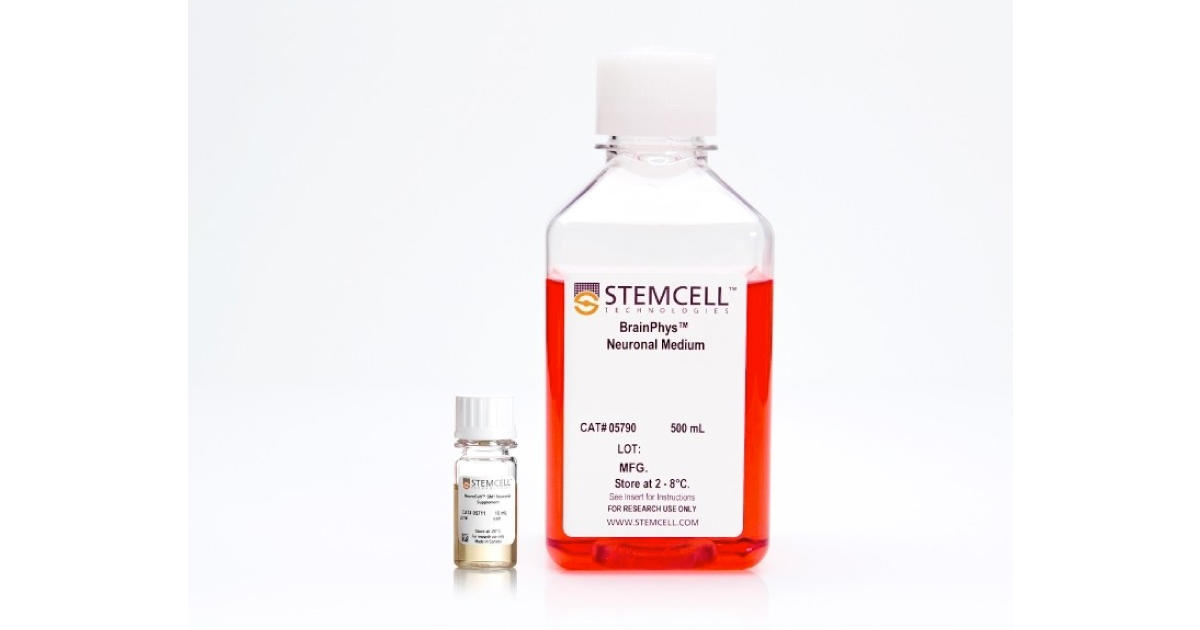
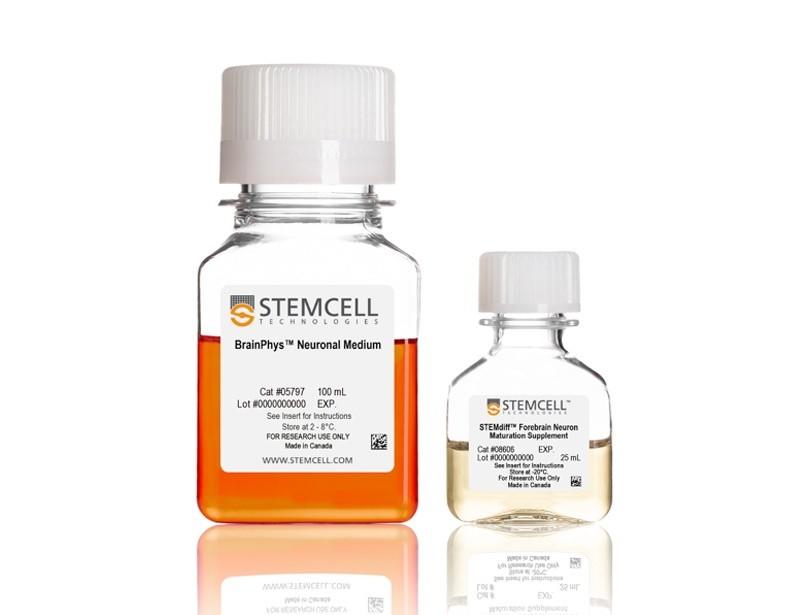
得られた前脳ニューロンは、STEMdiff™ Forebrain Neuron Maturation Kit(商品コード:ST-08605)を使用して、さらに成熟させることが可能です。このフォワード・プログラミングシステムは複数のhPSC株で再現性が確認されています。in vitro での神経疾患研究に適した機能的なヒト由来ニューロンを安定して作製なため、動物実験への依存低減も期待できます。作製されたニューロンはまた、創薬研究における新しい評価手法(new approach methodologies: NAMs)に組み込みやすい、再現性の高いヒト由来モデルとしても有用です。一方、幹細胞から神経発生の中間段階をより忠実に再現したい研究者には、hPSCから段階的にニューロンへと分化誘導できるSTEMdiff™ Forebrain Neuron Differentiation Kit(商品コード:ST-08600) がご使用いただけます。
2018/05/14 12:00の製品情報

本製品は研究目的にのみ使用し、人や動物の医療用・臨床診断用・食品用としては使用しないようにご注意ください。
製品の特長
STEMdiffTM -TF Forebrain Induced Neuron Differentiation Kitで、迅速に高純度な興奮性グルタミン酸作動性ニューロンの細胞集団が得られます
- 迅速:hPSC(ヒト多能性幹細胞)から、わずか5日で機能的な神経細胞を作製
- 安心・効率的:ゲノムへの組み込みリスクなしに、NGN2の過剰発現によって高純度の興奮性グルタミン酸作動性ニューロン集団を生成
- 高い再現性:複数のhPSCラインにおいて、一貫性ある結果を実現
- 予測モデルにも対応:BrainPhys™培地を含むSTEMdiff™ Forebrain Neuron Maturation Kitとの併用で、神経活動をサポートし予測モデルに適した環境を提供
データ紹介
Figure 1. Schematic for STEMdiff™-TF Forebrain Induced Neuron Differentiation Kit Protocol for Generating Excitatory Glutamatergic Forebrain Neurons
Excitatory glutamatergic forebrain neurons are generated from hPSCs within five days using STEMdiff™-TF Forebrain Induced Neuron Differentiation Kit. This forward programming protocol employs a synthetic mRNA-based system to deliver the transcription factor NGN2, without the use of viral vectors or genomic integration. PluriSIn-1 (Catalog #72822) is used to selectively induce apoptosis in any residual undifferentiated hPSCs within the culture. The resulting highly pure neurons can be further matured using STEMdiff™ Forebrain Neuron Maturation Kit (Catalog #08605). All components of STEMdiff™-TF Forebrain Induced Neuron Differentiation Kit are indicated in teal. hPSCs = human pluripotent stem cells; NGN2 = Neurogenin 2. Scale bar = 100 μm.
Figure 2. Practical Comparison of Forebrain Neuron Differentiation Approaches
This table compares three commonly used methods for generating forebrain neurons: DIY forward programming, STEMdiff™-TF Forebrain Induced Neuron Differentiation Kit, and directed differentiation. The data represent general performance characteristics derived from published protocols and typical laboratory experience. Qualitative descriptors (e.g., Low, Moderate, High) are based on internal benchmarking and published literature. Actual outcomes may vary depending on the hPSC line used, assay conditions, and level of protocol optimization. DIY = Do It Yourself; hPSC = human pluripotent stem cell; HTS = high throughput screening.
Figure 3. Highly Pure Neuron Cultures Are Generated Using STEMdiff™-TF Forebrain Induced Neuron Differentiation Kit
(A) Representative ICC images of neurons differentiated from H9 hESC and Healthy Control Human iPSC Line, Female, SCTi003-A (Catalog #200-0511) on Day 5 of neuronal differentiation with STEMdiff™-TF Forebrain Induced Neuron Kit show widespread neuronal induction, with cells stained for TUBB3 (green), MAP2 (magenta), SYN1 (red), and nuclei labeled with DAPI (blue). Scale bars = 100 µm. (B) Quantification of ICC data of pan-neuronal markers on Days 5 and 21. Neurons generated with the STEMdiff™-TF Forebrain Induced Neuron Kit exhibit high expression of TUBB3 at Day 5 and increasing expression of intermediate/maturing (MAP2), and pre-synaptic (SYN1) markers by Day 21, consistent with progressive neuronal maturation. Data was collected from four hPSC lines, with 4 - 8 replicates per line. Bar graphs show mean ± SD. ICC = immunocytochemistry; hPSC = human pluripotent stem cell.
Figure 4. Neurons Generated Using STEMdiff™-TF Forebrain Induced Neuron Differentiation Kit Can Be Co-Cultured with Astrocytes to Model Cell–Cell Interactions and Enhance Neuronal Activity In Vitro
(A) Representative ICC images of neurons derived from Healthy Control Human iPSC Line, Female, SCTi003-A (Catalog #200-0511) using STEMdiff™-TF Forebrain Induced Neuron Differentiation Kit, co-cultured with Human iPSC-Derived Astrocytes (Catalog #200-0980), and maintained in STEMdiff™ Forebrain Neuron Maturation Kit (Catalog #08605). Cells were stained for MAP2 (magenta; neuronal dendritic marker), GFAP (green, astrocyte marker), and DAPI (blue, nuclei). GFAP-positive astrocytes exhibited uniform distribution and characteristic morphology, distributed across the neuronal network. MAP2-positive neurons together with GFAP-positive astrocytes demonstrates successful co-culture. (B) MEA recordings demonstrate that neurons generated using STEMdiff™-TF Forebrain Induced Neuron Differentiation Kit exhibit spontaneous spiking activity one week after transitioning to STEMdiff™ Forebrain Neuron Maturation Medium. Activity metrics—including mean firing rate, number of active electrodes, network bursts, and synchrony index—increase steadily over the five-week recording period. Co-culture with Human iPSC-Derived Astrocytes (magenta) significantly enhances neuronal function, with higher spike frequency and more synchronized bursting activity compared to neurons cultured alone (grey). These results indicate accelerated and more robust neuronal maturation in the presence of astrocytes. Data are presented as mean ± SD (n = 6 wells per group). (C) Representative MEA raster plots comparing neuron-only cultures and neuron–astrocyte co-cultures at Weeks 2, 3, and 5 in STEMdiff™ Forebrain Neuron Maturation Media. Neuron-astrocyte co-cultures exhibit earlier onset and greater intensity of network activity, with more prominent and synchronized bursts emerging as early as Week 1 and peaking by Week 5. These patterns indicate enhanced network formation and functional synapse development supported by neuron-astrocyte co-culture. Raster plots display detected spikes (black lines), single channel bursts (blue lines; a collection of at least 5 spikes, each separated by an ISI of no more than 100 ms), and network bursts (pink boxes; a collection of at least 50 spikes from a minimum of 35% of participating electrodes, each separated by an ISI of no more than 100 ms). hPSCs = human pluripotent stem cells; ICC = immunocytochemistry; MEA = multielectrode array; ISI = inter-spike interval.
Figure 5. Neurons Generated Using STEMdiff™-TF Forebrain Induced Neuron Differentiation Kit Can Be Tri-Cultured with Astrocytes and Microglia to Model Cell–Cell Interactions In Vitro
Representative ICC images show neurons derived from Healthy Control Human iPSC Line, Female, SCTi003-A (Catalog #200-0511) using STEMdiff™-TF Forebrain Induced Neuron Differentiation Kit, tri-cultured with Human iPSC-Derived Astrocytes (Catalog #200-0980) and microglia generated using STEMdiff™ Microglia Differentiation Kit (100-0019). Cells were stained for GFAP (green, astrocyte marker), MAP2 (Magenta, neuronal dendritic marker), IBA1 (cyan, microglia marker), and DAPI (gray, nuclei). The presence of MAP2-positive neurons, GFAP-positive astrocytes, and IBA1-positive microglia confirms the successful establishment of a tri-culture system, demonstrating compatibility and integration of all three cell types in a shared in vitro environment. Scale bar = 100 μm; ICC = immunocytochemistry; iPSC = induced pluripotent stem cell; hPSC = human pluripotent stem cell.
Figure 6. Functional Pharmacological Assessment Using MEA Reveals Reversible Modulation of Neuronal Activity by 4-AP and GABA in Co-Cultures Generated Using STEMdiff™-TF Forebrain Induced Neuron Differentiation Kit and Astrocytes
Quantitative analysis of neuronal activity in neurons derived from H9 hPSCs (black) or Healthy Control Human iPSC Line, Female, SCTi003-A (Catalog #200-0511) using STEMdiff™-TF Forebrain Induced Neuron Differentiation Kit, co-cultured with Human iPSC-Derived Astrocytes (Catalog #200-0980), and maintained in STEMdiff™ Forebrain Neuron Maturation Kit (Catalog #08605) assessed using the Maestro MEA™ System (Catalog #200-0887). Cultures were treated with either 50 or 100 µM 4-AP (Potassium channel blocker), or DMSO vehicle control, or 3 or 30 µM GABA (inhibitory neurotransmitter) or water vehicle control. Cultures were incubated with compounds for 1 hour, after which neuronal activity was recorded (Treatment; grey bars). Following treatment, cultures were washed and fed with fresh maturation medium, and spontaneous activity was recorded 24 hours later (Recovery; teal bars). (A) 4-AP treatment significantly increased mean firing rate and network bursting, both of which recovered upon washout. (B) GABA treatment significantly reduced mean firing rate, network bursting, and synchrony index, all of which recovered upon washout. Data were normalized to each culture’s baseline activity, defined as spontaneous activity recorded immediately prior to treatment. Dots represent technical replicates. n = 1 – 2 cell lines. MEA = multielectrode array; 4-AP = 4-aminopyridine.
Figure 7. Temporal Gene Expression Profile of Neurons Generated Using STEMdiff™-TF Forebrain Induced Neuron Differentiation Kit Reveals Loss of Pluripotency and Progressive Acquisition of Neuronal Identity and Maturity
(A) PCA of bulk RNA sequencing data from three hPSC lines (SCTi003-A, H9, and SCTi004-A) collected across six time points (Days 0 – 5 and 21) throughout differentiation using STEMdiff™-TF Forebrain Induced Neuron Differentiation Kit highlighting distinct transcriptomic shifts from pluripotency to mature neuronal identity. Symbols indicate cell lines (circle: SCTi003-A, square: H9, diamond: SCTi004-A). Tight clustering of samples at each time point across all lines indicates reproducible and consistent neuronal programming. (B) Heatmap shows transcript levels of selected genes across stages of differentiation (Days 0 – 5 and Day 21) using STEMdiff™-TF Forebrain Induced Neuron Differentiation Kit. Pluripotency-associated genes (POU5F1/OCT4, NANOG, SOX2) were rapidly down-regulated upon induction, confirming the loss of stem cell identity. NGN2 target genes (NEUROG2, NEUROD1, DCX) were up-regulated during early programming stages (Days 1 – 3), reflecting activation of neuronal lineage specification. Pan-neuronal markers (TUBB3, MAP2, POU3F2) and synaptic genes (SYN1, VAMP2, DLG4) increased progressively, with peak expression by Day 21, indicating neuronal commitment. Late-stage up-regulation of post-synaptic genes (GRIN1, GRIA1/3) and glutamatergic neuron markers (SLC17A7, SATB2, CAMK2A, TBR1, SYT1) on Day 21 highlights advanced maturation and forebrain glutamatergic identity. Expression values are normalized and color-coded from low (blue) to high (red), capturing the dynamic transcriptional changes that underlie neuronal differentiation and maturation. PCA = principal component analysis; hPSC = human pluripotent stem cell; NGN2 = Neurogenin 2.
Figure 8. Single-Cell Transcriptomics Confirms Differentiation From Pluripotency To Excitatory Glutamatergic Neurons Using STEMdiff™-TF Forebrain Induced Neuron Differentiation Kit
(A) UMAP visualization of single-cell RNA sequencing data from hPSCs (Day 0) and neurons at Day 5 and Day 21 generated using STEMdiff™-TF Forebrain Induced Neuron Differentiation Kit. Distinct clustering shows the progressive transcriptional transition from pluripotent to neuronal states. UMAPs highlight decreased expression of pluripotency markers (OCT4/POU5F1, NANOG) by Day 5, accompanied by induction of neuronal lineage markers (TUBB3, MAP2, SYP), which become uniformly expressed by Day 21. (B) Violin plots and UMAP projections from Day 21 neurons confirm enrichment of the excitatory glutamatergic lineage which predominantly express markers SLC17A6 (vGLUT2) and GLS. In contrast, markers of alternative neuronal subtypes show minimal or absent expression: GABAergic (GAD1, DLX2, PVALB), dopaminergic (TH, NR4A2, SLC6A3), and serotonergic (TPH2, SLC6A4, FEV). Low-level expression of cholinergic markers (CHAT, PHOX2B, ACHE) was detected. hPSCs = human pluripotent stem cells.