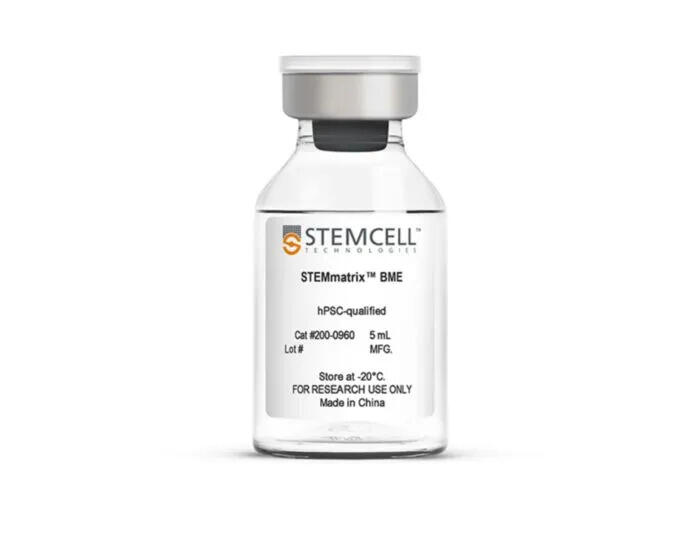
STEMCELL Technologies STEMmatrix STEMmatrix BME
- 研究用
- 新製品
STEMmatrix™ BMEは、Tissue culture-treatedの培養器にコーティングして使用する基底膜抽出物です。フィーダーフリーの培養でヒト多能性幹細胞(hPSC)の増殖・分化をサポートします。
STEMmatrix™ BMEはマウスEngelbreth-Holm-Swarm(EHS)肉腫から抽出された可溶性の基底膜マトリックスで、hPSCの培養に使用可能であることが確認されています。この細胞外マトリクス(ECM)ベースのハイドロゲルは、主要なECMタンパク質(IV型コラーゲン、エンタクチン、ヘパラン硫酸プロテオグリカン、ラミニンなど)および必須成長因子(EGF、bFGF、IGF-1、TGF-β、VEGFなど)を豊富に含み、in vivo環境を忠実に再現して旺盛な細胞増殖をサポートします。本品とフィーダーフリーで使用可能なhPSC維持用培地であるmTeSR™ Plus、mTeSR™1、TeSR™-E8™、eTeSR™ などと併用することで、hPSC株を未分化状態で維持することができます。維持した細胞はhPSCの特徴的な形態を維持し、OCT4やTRA-1-60といった未分化細胞マーカーを発現しており、3胚葉すべてに分化する能力を有します。
2018/05/14 12:00の製品情報

本製品は研究目的にのみ使用し、人や動物の医療用・臨床診断用・食品用としては使用しないようにご注意ください。
製品の特長
STEMmatrix™ BMEは、フィーダーフリーの培養においてhPSCの未分化性と細胞増殖をサポートし、高品質な細胞維持を可能にします
- 細胞外マトリクスタンパク質と必須成長因子を豊富に含有したhPSC適合の基底膜マトリクスが、安定した細胞増殖をサポート
- TeSRTM系統の培地と組み合わせることで、hPSC培養に最適な環境を提供できるフィーダーフリーなメンテナンスプロトコールを実現
- 生体内条件を再現し、hPSCの増殖・分化を促進する生理学的関連性の高い培養環境を構築
- 健全な形態、未分化マーカーの発現、三胚葉分化能を維持した高品質なhPSC培養を可能に
データ紹介
Figure 1. Robust hPSC Expansion Is Observed in STEMmatrix™ BME Cultures, with Comparable Performance to Corning® Matrigel®
Average fold expansion of clump-passaged hPSCs (± SEM) over 10 passages was similar between cultures grown on STEMmatrix™ BME and Corning® Matrigel® hESC-Qualified Matrix. Cultures were maintained in mTeSR™ Plus (Catalog #100-0276) or mTeSR™1 (Catalog #85850) media at 37°C and passaged every 7 days. Graph shows pooled data from H9 and SCTi003-A (Catalog #200-0511) hPSC cultures.
Figure 2. STEMmatrix™ BME Supports Large hPSC Colony Sizes, with Comparable Performance to Corning® Matrigel®
Colony sizes of H9 and SCTi003-A (Catalog #200-0511) hPSCs grown on STEMmatrix™ BME in mTeSR™ Plus (Catalog #100-0276) or mTeSR™1 (Catalog #85850) media (± SD), averaged over 10 passages, were comparable to those grown on Corning® Matrigel® hESC-Qualified Matrix.
Figure 3. Normal hPSC Morphology Is Observed in Cells Cultured on STEMmatrix™ BME
Microscope images are shown of (A) H9 and (B) SCTi003-A (Catalog #200-0511) PSCs grown on STEMmatrix™ BME or Corning® Matrigel® hESC-Qualified Matrix in either mTeSR™ Plus (Catalog #100-0276) or mTeSR™1 (Catalog #85850) media, all o f which exhibit comparable, normal morphology. Cells were imaged on the day of passage (Day 7) and display a highly multilayered and densely packed appearance.
Figure 4. hiPSC Morphology Is Consistent Across STEMmatrix™ BME Lots and Comparable to Corning® Matrigel® Control
Representative images show WLS-1C hiPSCs cultured in mTeSR™ Plus (Catalog #100-0276) on Corning® Matrigel® hESC-Qualified Matrix or one of three STEMmatrix™ BME lots. Morphology was normal and consistent across all STEMmatrix™ BME lots tested, and comparable to the Matrigel® control.
Figure 5. Undifferentiated Cell Markers Are Highly Expressed in hPSCs Grown on STEMmatrix™ BME, with Comparable Expression Levels to Corning® Matrigel®
H9 and SCTi003-A (Catalog #200-0511) hPSCs were cultured in mTeSR™ Plus (Catalog #100-0276) or mTeSR™1 media (Catalog #85850) with either STEMmatrix™ BME or Corning® Matrigel® hESC-Qualified Matrix, then characterized for undifferentiated cell markers using flow cytometry. Within each cell and media pairing, STEMmatrix™ BME and Corning® Matrigel® conditions exhibited similar expression levels of the undifferentiated cell markers OCT4 (A) and TRA-1-60 (B). Graphs show the average gene expression (± SD) from duplicate wells every 5 passages, up to a total of 10 passages.
Figure 6.hPSCs Grown on STEMmatrix™ BME and Differentiated into Mesoderm, Endoderm, and Ectoderm Cells Show High Expression of Germ Line-Specific Markers, with Results Comparable to Corning® Matrigel®
Fold expression changes of mesoderm-, endoderm-, and ectoderm-specific genes are shown for cells derived from the SCTi003-A hiPSC line (Catalog #200-0511) that were grown on either STEMmatrix™ BME or Corning® Matrigel® in mTeSR™ Plus (Catalog #100-0276). Cells were grown and differentiated using the STEMdiff™ Trilineage Differentiation Kit (Catalog #05230) and STEMdiff™ SMADi Neural Induction Kit (Catalog #08581) on each respective matrix, and harvested once confluent. qPCR analysis was completed using the Human Pluripotent Stem Cell Trilineage Differentiation qPCR Array (Catalog #07515) and STEMCELL’s online qPCR analysis tool. For additional information about the trilineage gene expression markers included in this evaluation, or to explore the qPCR analysis tool, visit www.stemcell.com/qPCRanalysis.
Figure 7. hiPSC-derived Mesoderm, Endoderm, and Ectoderm Cells Grown on STEMmatrix™ BME Demonstrate High Expression of Germ Line-Specific Markers in Flow Cytometry Analysis
WLS-1C hiPSCs were grown on STEMmatrix™ BME or Corning® Matrigel® hESC-Qualified Matrix in either (A) mTeSR™ Plus (Catalog #100-0276) or (B) mTeSR™ 1 (Catalog #85850), then dif ferentiated to mesoderm, endoderm, and ectoderm cells using the STEMdiff™ Trilineage Differentiation Kit (Catalog #07515) on each respective matrix. Once confluent, cells were harvested, and expression of germ line-specific markers was evaluated using flow cytometry. The mesoderm, endoderm, and ectoderm-specific markers were highly expressed in each respective germ line, and expression levels (± SD) were comparable between STEMmatrix™ BME and Corning® Matrigel® conditions.
Figure 8. hPSCs Cultured on STEMmatrix™ BME Are Karyotypically Normal
A genetic analysis of H9 (P10) hPSCs grown on STEMmatrix™ BME or Corning® Matrigel® hESC-Qualified Matrix in mTeSR™1 medium (Catalog #85850) was performed using the hPSC Genetic Analysis Kit (Catalog #07550). No karyotypic abnormalities were observed in either STEMmatrix™ BME or Corning® Matrigel® conditions. Data are reported as fold expression change relative to a genomic DNA control (± SD).
Figure 9. hPSCs Grown on STEMmatrix™ BME Exhibit Robust hPSC Expansion, High Expression of Undifferentiated Markers, and Normal Morphology, with Comparable Results to Corning® Matrigel®
H9 hPSCs were expanded in single-cell culture on either STEMmatrix™ BME or Corning® Matrigel® hESC-Qualified Matrix in eTeSR™ maintenance medium (Catalog #100-1215). Cultures were incubated at 37°C and passaged every 4 or 5 days. (A) Average fold expansion per day (±SD), calculated over 10 passages, was similar between the two matrices. (B) Accumulated cell numbers (±SD), shown over 10 passages, were also comparable between the two matrices. (C) Expression levels of OCT4 and TRA-1-60 (±SD), markers of the undifferentiated state, were similar between STEMmatrix™ BME and Corning® Matrigel® conditions. Bars represent the average of duplicate wells every 5 passages, up to a total of 10 passages. (D) hPSCs grown on STEMmatrix™ BME or Corning® Matrigel® demonstrated normal, comparable morphology in microscope images. Cells were imaged on the day of passage (Day 4 or 5) and appeared densely packed.