STEMCELL Technologies CloneR CloneR 3
- 研究用
- 新製品
- キャンペーン
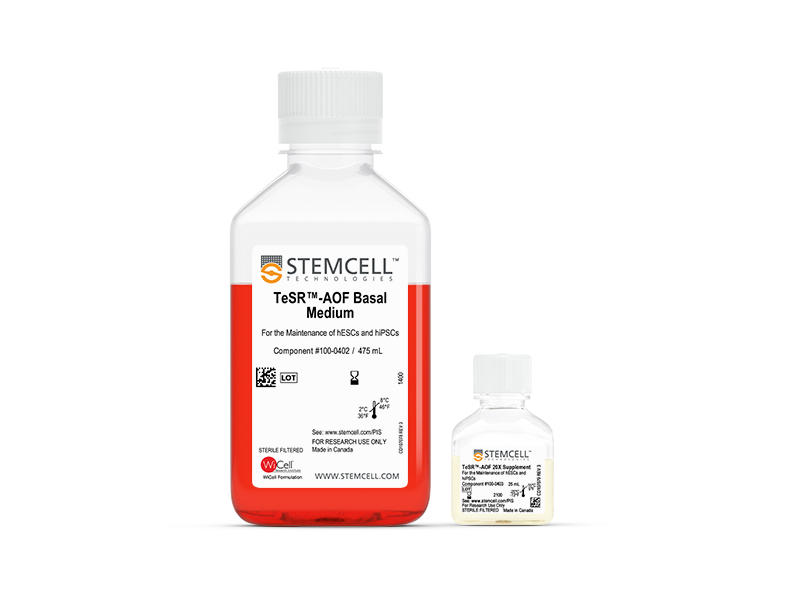
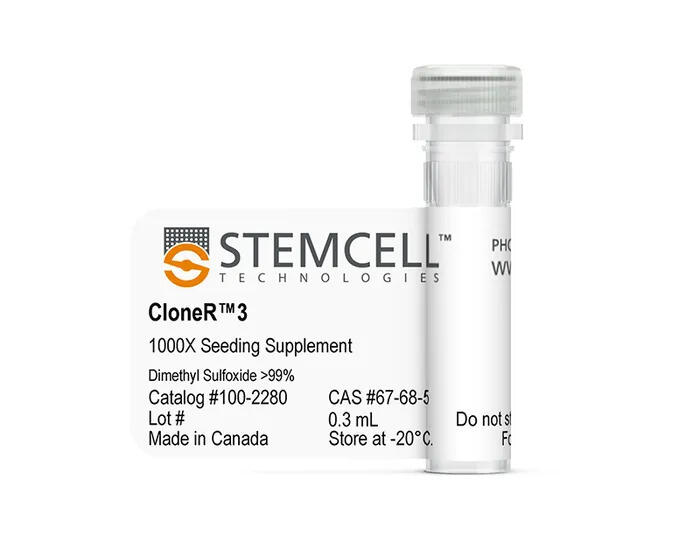
CloneR™3 は、動物由来成分不含(AOF)ワークフローにおいて、ヒト多能性幹細胞(hPSC)のクローニング効率、生存率、および増殖性を向上させます。化学的に成分が明確な製品であり、製造過程で動物由来原料を一切使用していません。CloneR™3 は、2D単層培養では TeSR™-AOF (商品コード:ST-100-0401) と、3D懸濁培養では TeSR™-AOF 3D (商品コード:ST-100-0720)と併用するよう最適化されており、トレーサビリティやウイルス安全性の向上が求められるワークフローに役立ちます。
AOFおよび3DワークフローでCloneR™3 を使用することにより、クローニング効率および播種効率向上、凍結融解後やエレクトロポレーション後の細胞の回復性の改善、細胞収量と生存率アップが可能となります。また、CloneR™2 など他の生存補助サプリメントと比較して、細胞株間でより安定した性能を発揮します。この効果は、2D単層培養から3D懸濁培養への移行時に特に顕著に見られます。なお、mTeSR™ Plus (商品コード:ST-100-0276))を用いた2D単層培養における性能はCloneR™2と同等です。
CloneR™3は高濃度製剤(1000倍濃縮)のため、hPSC培養系に添加しても培地の希釈を最小限に抑えることができます。これにより、培地組成や重要な増殖因子濃度を変えることなく正確な添加が可能となり、培養条件の安定性を維持することができます。
2018/05/14 12:00の製品情報

本製品は研究目的にのみ使用し、人や動物の医療用・臨床診断用・食品用としては使用しないようにご注意ください。
製品の特長
動物由来成分不含のCloneR™ 3で、ヒト多能性幹細胞のクローニング効率、生存率、および増殖性を向上
- 安心:製造過程において動物由来原料不使用、化学的に成分明確なサプリメントにより培養時の不測のリスクを最小化
- 効率化:TeSR™-AOF 培養系における細胞のクローニング性能、ストレス後の回復性、および培養の一貫性を向上
- 収量アップ:3D懸濁培養における細胞収量と生存率が増加
- 便利:高濃度(1000倍濃縮)製剤により、培地を希釈せずに添加可能
Figure 1. CloneR™3 Improves Clonal Generation Following Single-Cell Deposition of hPSCs
Single-cell deposition is the gold standard for clonal derivation, but is typically limited by low efficiency. Four hPSC lines (H1, H9, SCTi003-A, and WLS-1C) were seeded using FACS-based cell seeding to deposit 1 cell per well of a 96-well plate. Clones generated in TeSR™-AOF supplemented with CloneR™3 demonstrate significantly improved cloning efficiency when compared to clones generated with Rho kinase inhibitor (Y-27632) or CEPT. Across four cell lines tested, CloneR™3 had an average cloning efficiency of 29.6 ± 11.8%. In contrast, Y-27632 and CEPT had average cloning efficiencies of 9.6 ± 8.5% and 11.6 ± 8.3%, respectively, with 7 biological replicates per cell line on plates precoated with LN-521. A two-tailed unpaired t-test was conducted for each cell line comparison where * denotes p < 0.05, ** denotes p < 0.01, and *** denotes p < 0.001.
Figure 2. CloneR™3 Improves Cloning Efficiency Compared to Y-27632
Four hPSC lines (H1, H9, SCTi003-A, and WLS-1C) were seeded at clonal density (50 cells/cm²) in TeSR™-AOF supplemented with Y-27632 or CloneR™3 on Vitronectin XF™. (A) Supplementation with CloneR™3 results in increased cloning efficiency of hPSCs when compared to Y-27632. (B) Representative whole-well images of two hPSC lines (H9 and WLS-1C) on Day 10 after seeding show the increase in the number of clones observed per well when supplemented with CloneR™3. A two-tailed unpaired t-test was conducted for each cell line comparison where * denotes p < 0.05.
Figure 3. CloneR™3 Is Compatible with Single-Cell Seeding of hPSCs
Three hPSC lines (H1, H9, and SCTi003-A) were seeded as single cells at 9 x 10³ to 14 x 10³ cells/cm² on Laminin-521 in TeSR™-AOF supplemented with Y-27632, CEPT, or CloneR™3 for the first 24 hours. After five days in culture, cells were harvested and counted. In the H9 and SCTi003-A cell lines, supplementation with CloneR™3 results in a trend toward improved fold expansion when compared with Y-27632 or CEPT. Each point represents one biological replicate averaged from two technical replicates. Bars represent the mean ± SD from the average of three biological replicates.
Figure 4. CloneR™3 Improves Cell Yields During the Transition from 2D to 3D Culture
The transition from static 2D culture to 3D suspension culture is a bioprocessing bottleneck that can be stressful for hPSCs and may result in lower expansion on the first passage after seeding. Four hPSC lines (H1, SCTi003-A, SCTi004-A, and STiPS-M001) maintained in 2D culture conditions were dissociated to small clumps using ReLeSR™ and seeded at a density of 5 x 10⁴ cells/mL on an orbital shaker (2.5 cm orbital diameter) at 70 rpm. Across four cell lines, hPSCs seeded into TeSR™-AOF 3D supplemented with CloneR™3 exhibited cell yields 1.58-fold higher than Y-27632-supplemented cells after four days in culture. Each point represents one biological replicate averaged from two technical replicates. Bars represent the mean ± SD from the average of three biological replicates. A two-tailed unpaired t-test was conducted for each cell line comparison where * denotes p < 0.05.
Figure 5. CloneR™3 Improves Yields of High-Quality hPSCs During Routine 3D Culture
Four hPSC lines (H9, STiPS-M001, SCTi003-A, and SCTi004-A) adapted for one passage to 3D suspension culture were dissociated into small clumps with GCDR, seeded at a density of 5 x 10⁴ cells/mL in TeSR™-AOF 3D supplemented with CloneR™3 or Y-27632 and clump passaged with GCDR every 3 to 4 days for 5 passages. (A) Cells supplemented with CloneR™3 demonstrate higher cell yields after four days in culture when compared to cells supplemented with Y-27632. Each point represents one biological replicate averaged from two technical replicates. Bars represent the mean ± SD from the average of three biological replicates. A two-tailed unpaired t-test was conducted for each cell line comparison where * denotes p < 0.05 and ** denotes p < 0.01. (B) Images of SCTi003-A and SCTi004-A aggregates supplemented with CloneR™3 and Y-27632 show typical morphology indicative of high-quality, healthy hPSCs. (C) Aggregates were then dissociated to single cells, stained for the undifferentiated markers TRA-1-60 and OCT4, and analyzed by flow cytometry. Cultures supplemented with CloneR™3 and Y-27632 maintained high expression (>90%) of TRA-1-60 and OCT4. Bars represent the mean ± SD from the average of two technical replicates.
Figure 6. CloneR™3 Improves Cell Yields Following Single-Cell Passaging of 3D Aggregate Cultures
Passaging 3D hPSC aggregates as single cells can be more stressful than traditional clump passaging, especially when culturing more sensitive cell lines or seeding at lower densities. Aggregates from four hPSC lines (H9, STiPS-M001, SCTi003-A, and SCTi004-A) were dissociated to single cells using GCDR and re-seeded at a cell density of 5 x 10⁴ cells/mL. Single-cell seeded hPSC aggregates cultured in TeSR™-AOF 3D supplemented with CloneR™3 demonstrate higher cell yields after four days in culture when compared to cells seeded in TeSR™-AOF 3D supplemented with Y-27632. Across the four cell lines tested, Y-27632 and CloneR™3 had an average cell yield of 5.7 x 10⁵ ± 19.3%, and 7.4 x 10⁵ ± 11.8%, respectively. Each point represents one biological replicate averaged from two technical replicates. Bars represent the mean ± SD from the average of three biological replicates. A two-tailed unpaired t-test was conducted for each cell line comparison where ** denotes p < 0.01.
Figure 7. CloneR™3 Improves Post-Thaw Recovery of Cryopreserved Single Cells in 3D Suspension Culture
Thawing cryopreserved hPSCs is a stressful event that typically results in significant cell loss and reduced post-thaw expansion. SCTi003-A and SCTi004-A aggregates that were cryopreserved as single cells were seeded into TeSR™-AOF 3D supplemented with CloneR™3 or Y-27632. Thawed single cells were seeded at a cell density of 1 x 10⁵ cells/mL into non-tissue culture-treated six-well plates on an orbital shaker. Cryopreserved single cells supplemented with CloneR™3 demonstrate higher post-thaw recovery after four days in culture when compared to cryopreserved single cells supplemented with Y-27632. Across both cell lines tested, Y-27632 and CloneR™3 had an average cell yield of 4.1 x 10⁵ ± 10.5%, and 7.3 x 10⁵ ± 3.6%, respectively. Each point represents one biological replicate averaged from two technical replicates. Bars represent the mean ± SD from the average of two biological replicates.